
Why (almost) no transaction is simple
Economic transactions have an air of simplicity: if you ask no more than what I am offering, or if what I offer is at least what you are willing to accept, we can trade–but it's not always that simple


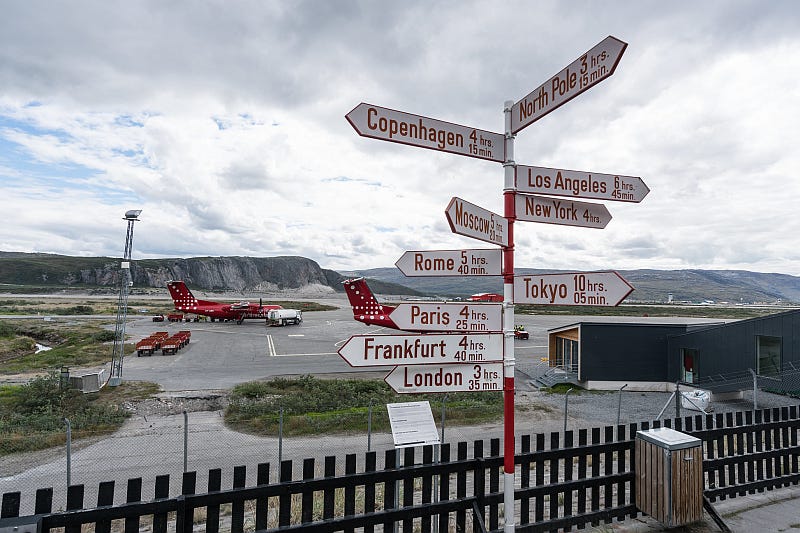
Until very recently, US President Donald Trump had set his eyes on Greenland, an autonomous territory, part of Denmark. He offered to buy it, implied he might annex it by military force, and threatened to levy additional import tariffs for those European countries that participated in a Danish-led reconnaissance mission to Greenland, unless they supported his efforts to acquire the island. (At the Davos WEF earlier this week, Trump stated he has no intention to take Greenland by force and walked back the tariffs.)
A transfer of Greenland from Denmark to the US can be seen as an economic transaction like any other. Denmark has consistently rejected initiatives (from Trump and earlier administrations), but it occurred to me that this most recent moves may have altered the likelihood of success – in two opposing ways. It is indeed possible to argue both that the chances of a ‘deal’ (to use the president’s favourite term) have deteriorated, and that they have improved. Isn’t that odd?
Minutiae matter
A change of sovereignty may well be an economic transaction, but a close look suggests it is by no means a simple one. It certainly deviates from a typical market transaction in which sellers offer their wares, which buyers look to acquire. Trump’s initial offer of buying Greenland was more akin to someone ringing your bell stating that they want to purchase part of your garden. Not standard, perhaps, but perfectly reasonable. For example, if your neighbours would gain a specific benefit by acquiring a piece of your garden, it’d make sense for them to approach you and make an offer.

Many of our possessions serve a practical purpose, others we are in some way attached to. De facto, they are therefore worth more to us than the market value. A famous experiment by Daniel Kahneman, Jack Knetsch and Richard Thaler demonstrated this ‘endowment effect’ **: half of a group of students were given a mug, and members of the other half could make an offer to buy one from someone in the lucky half. What those with a mug wanted to sell it for was on average about double what the others were prepared to offer. Unsolicited offers – whether for Greenland, or for a section of our back yard – will thus often meet a higher demanded price than if it was explicitly ‘for sale’. This is like a psychological premium to secure the owner’s willingness to sell, over and above the value of the object of the potential transaction.
A counterfactual is that the owner of the object in question has concluded it no longer serves a purpose, and selling it would release resources that can be put to better use. Another, perhaps more relevant, one is that the owner faces some adversity, the response to which requires rapid availability of resources. If we receive an unexpected inheritance tax bill, we may decide to sell part of our garden to raise the money; if Denmark were to meet say, a natural disaster or an economic misfortune, the government might consider selling the island voluntarily to finance its response, and hence more likely to do so than in response to an unsolicited offer.
There’s more to a transaction than transacting
But in this specific case, the adversity was not unconnected to the American desire to acquire Greenland: the economic misfortune was the threat of tariffs by the interested party, specifically linked to the refusal to hand over the territory. It is as if the neighbours who are eyeing our plot of land would threaten to play loud music all day long until we agreed to let them have that piece of garden. The harm might be identical to genuine misfortune, but deliberate coercion taints the transaction itself: it is no longer dealing with a problem, but rewarding extortion. Such an action may well provoke an emotional response which drastically reduces the likelihood of a compromise – a phenomenon known as psychological reactance.
This puts a spotlight on a range of further non-material considerations that lurk below the surface. Many transactions that look superficially irrational (because they leave us materially worse off) involve such immaterial elements. It is as if we place additional factors in the balance, which may outweigh material gains or losses. This piece of our garden may have special value for us that cannot simply be compensated with additional money – perhaps it is where a beloved pet used to like basking in the sunshine, or we do not want to spoil the integrity of the garden because the land has been in our family for many generations and we feel an obligation to maintain it for future ones. In Denmark and Greenland’s case, a strong feeling of sovereignty, self-determination and tradition, and a fundamental allegiance to Europe rather than to America, may overshadow economic considerations.
Even aspects unrelated to the object of the transaction may influence us. If our neighbours have been belittling or insulting us, or have shown to be impulsive and unreliable in the past, we may not be inclined to sell them anything, even if it would be a beneficial transaction. It is not hard to see how similar sentiments might play a role in Denmark and Greenland’s attitude.
Furthermore, some transactions cast their shadow forward. Imagine we are living in our ancestral home, and while we have no sentimental attachment to the plot of land our neighbours are after, our friends in the village and our siblings would take a dim view of our selling off part of it. Concern for our reputation might thus hold us back from what might otherwise be a sensible move. Denmark might similarly refuse to bow to American pressure to give up Greenland, thus signalling that coercive tactics don’t work, and that it places standing up for the NATO collective above its narrow self-interest.
Well beyond geopolitics and land sales, transactions often involve much more than a simple exchange of goods or services for money. From buying groceries to purchasing cars, from the jobs we choose to do to our hobbies, from where we choose to live to whom we marry, it rarely concerns just material gains and sacrifices and establishing whether the willingness to pay of one party exceeds the willingness to accept of the other. Every transaction is an intricate navigation exercise that involves cognitive biases, competing value systems, moral red lines, and multi-move games. If we want to judge others’ choices, this is worth bearing in mind.
For our own transactions too, it can be enlightening not only to try and understand the motives of the other party, but also to explore the complexity of our own reasons and emotions, and test how sound and solid our position really is.