
The Resonance Premium
We tend to value stuff based on its cost – except when we don’t

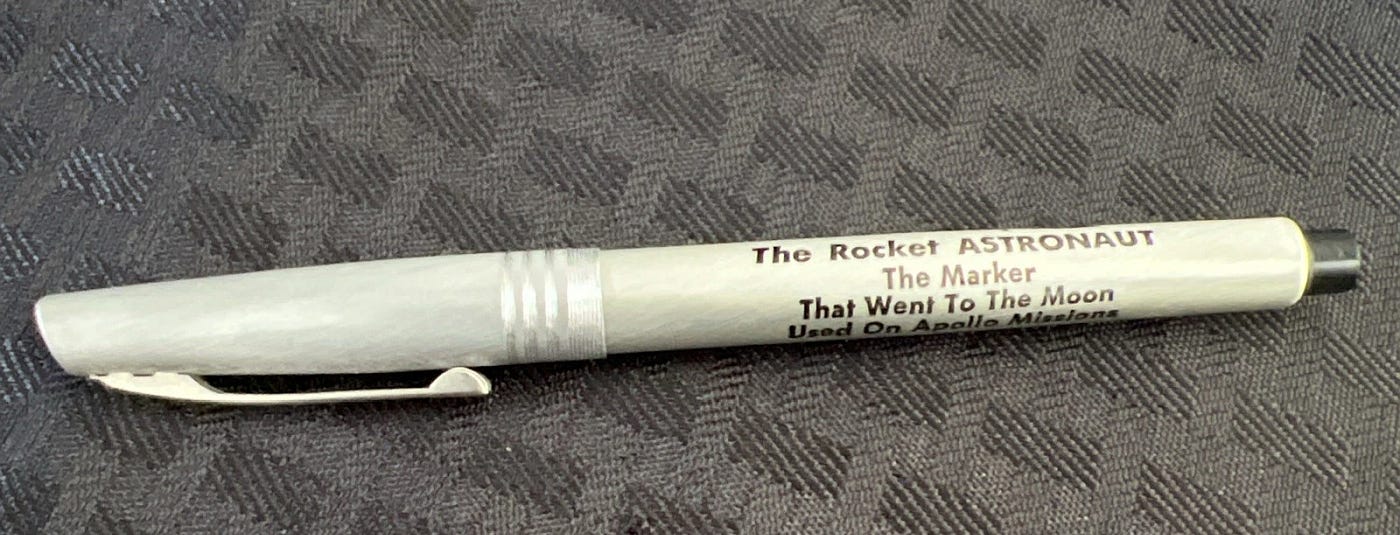
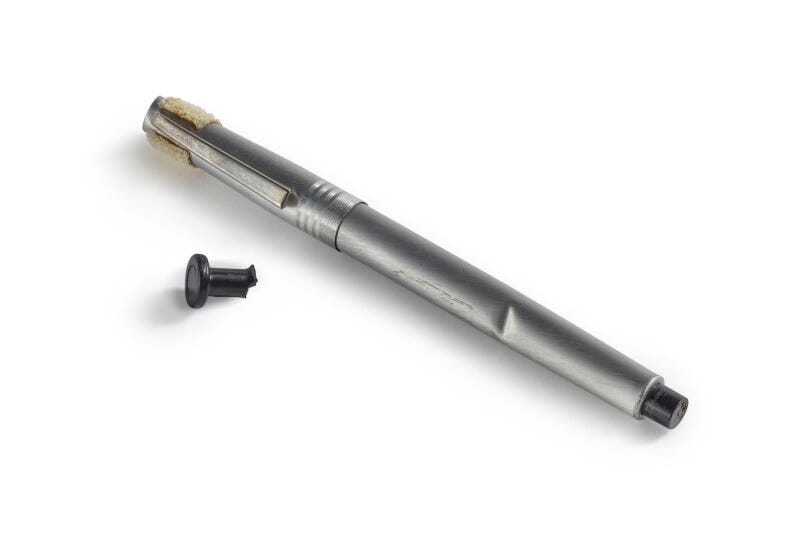
Vintage items, especially if they are no longer in production and sought-after, can fetch substantial multiples of their original cost. For example, a period pen, for sale in the late 1960s for less than $1, recently sold on eBay for $349. But on 15th July, Sotheby’s auctioned a similar vintage pen (together with a nondescript plastic component), which changed hands for $857,600. Close to a million for an old pen and a piece of plastic… isn’t that odd?
The items in question had been on board a NASA mission, and space stuff does command a premium – perhaps $10,000 for a pen and up to $50,000 for some components. But this pairing that went for nearly fifteen times as much had been on the Apollo-11 mission, one in astronaut Buzz Aldrin’s pocket, the other as a circuit-breaker on the lunar lander’s control panel. That component, found to have broken off upon return from the first excursion on the moon, was vital to start the engine of the lander to return to the capsule in orbit, and Aldrin used his Duro felt-tip pen to provide an improvised fix. (Its felt tip was crucial as it would not risk shorting the electrics of the lunar lander.) That background explains the massive price premium… but how, and why, can information multiply value so spectacularly?
Information, the immaterial cherry on the cake
This auction is a typical illustration of how certain items acquire a value that is vastly higher than its inherent material worth. Most commonly, an object’s age and rarity – typically the case for antiques – can be enough to drive up the price people are prepared to pay for objects that could be reproduced today for much less (and made to look exactly the same). Beyond mere scarcity, authenticity is also a potential source of value. We see it in, for example, mechanical devices, in particular classic motor vehicles. A car that is restored with original parts and still has the original paint will typically sell for more than one that has been modernized or altered in any way (even if the modification is a technical improvement – for example power steering or brakes, or more reliable electrics).
A different kind of authenticity applies where there is information about who owned or has been known to use an article. Psychologists George Newman and Paul Bloom researched the phenomenon of what they called contagion (the apparent transfer of some ‘essence’ of a person to an object), and established that the degree of physical contact a celebrity has had with an item influences how much collectors are willing to pay at an auction. (A sterilized item would fetch less, supposedly because the essence had been diluted.) We can see this played out for clothes, musical instruments, houses, cars and more. This could be seen as a more general variant of the value attributed to authenticated historic works of art, as stories of valuable works of art bought for pennies before being authenticated illustrate. Even when it’s not a celebrity but a dinosaur, authenticity bestows value: a museum-quality cast of T. Rex ‘Stan’ costs roughly $120,000, versus the $31.8 million paid for Stan’s actual fossilized bones – a factor 265.
Connecting with history… or with a story
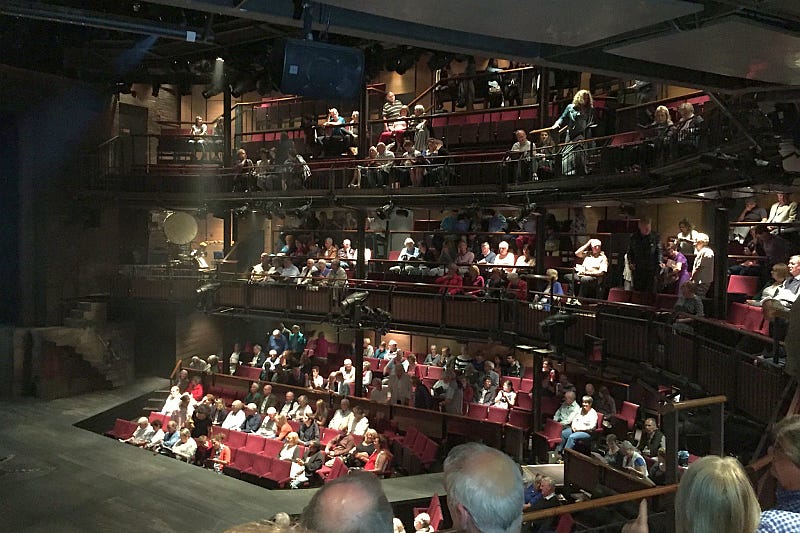
But also beyond buying and selling items, when we consider other ways to gauge perceived value, we see similar patterns. Imagine you’re visiting a place for the first time, and on a walk, the path forks into two. A sign describes the two options: both are largely equivalent, but one of them is actually an ancient path that can be traced back to the first century CE, when it linked two Roman settlements. Because of that connection, many people will prefer that route. Similarly, the Royal Shakespeare Theatre in Stratford-upon-Avon attracts many people preferring to experience a performance of one of the bard’s plays in his home town. In these cases, there are no plausible physical connections: the actual soil on which the Roman soldiers walked has long washed away by twenty centuries of rain and the trees lining the path were not even seeds back then, while the Stratford Theatre was built three centuries after Shakespeare’s death. Yet we still seem to treat these places as if the essence of the legionnaires can be felt on the path, and Shakespeare’s spirit is closer to the stage in Stratford than anywhere else.
Buzz Aldrin’s pen (and the accompanying broken switch) has something even more powerful, however, over and above authenticity, contagion and connection. It has a dramatic story, that touches everyone. The tale of two astronauts, this close to being irrevocably stranded on the moon forever, soon running out of food and drink, and eventually out of oxygen – and the simple pen that was their escape route, that very pen, is the pinnacle of uniqueness. More than a shirt worn by Lionel Messi, a signed photograph of Marilyn Monroe, or the Excalibur Roadster owned by Roy Orbison, objects that come with a vivid tale attached have profound universal appeal.
Imagination and trust
This extreme case, in which an object acquired a value more than 100,000-fold of its original inherent worth, shows that it is not just any ‘information’ that is the multiplier. It is information that activates our imagination. That activation is more intense when the object is more authentic (a genuine antique or fossil, a sympathetic car restoration), has had physical contact with a person we admire (an item of clothing or a musical instrument), has a clear role in history (the Roman path or the Shakespeare Theatre), and most of all when it was involved in a brush with disaster. That is what makes objects resonate with us, and for which we are willing to make a sacrifice – if not by offering an elevated price to buy it, then at least through making a special trip or standing in line to experience it.
But for our imagination to be rightfully triggered, another factor is essential: we need to believe the information is true. That means we must trust the source of the information, because there is almost never watertight proof that an object is what it is. We can only hope that the new owner of Buzz Aldrin’s pen will continue to loan it to the Smithsonian Museum, and that it will not need to be replaced by a copy.
Only when we are certain we are beholding the genuine article do we truly experience that resonance.