
The Moralization Gambit
Sometimes, when facing dilemmas that oppose means and ends, rather than confronting their complexity, we resort to the strategic invocation of a principle to resolve the tension

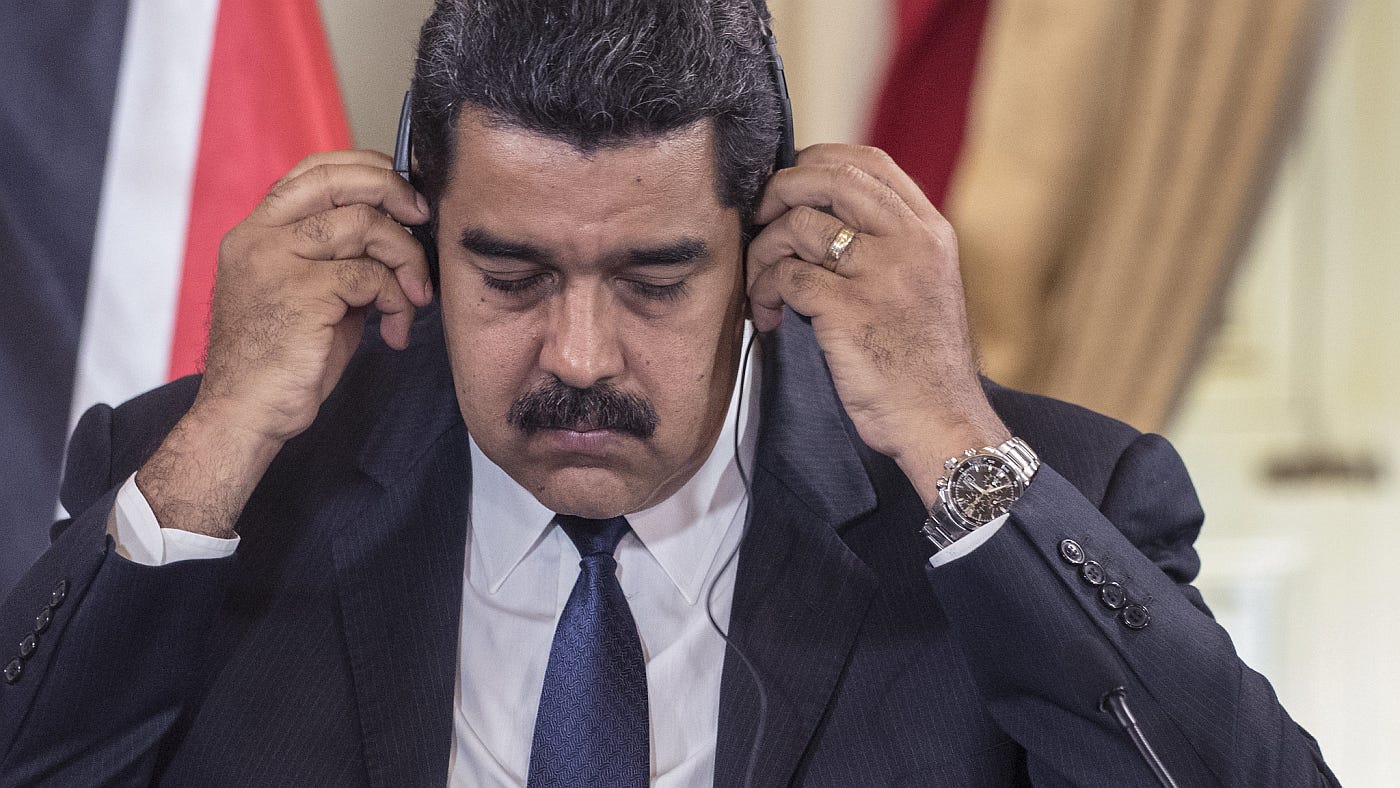
Last weekend, Nicolás Maduro, the president of Venezuela who declared victory in the widely disputed 2024 elections, and during whose tenure eight million Venezuelans fled the country, was captured and abducted by American special forces. This caught the world, still recovering from New Year celebrations, by surprise. It also divided the world in two sharply distinct camps: those in favour, and those against the raid. The conflict between the two sides can be seen as a common dilemma: did the end justify the means?
In a short post just a couple of days after the operation, economist and commentator Tyler Cowen observed that the Venezuelan stock market was up no less than 73% since Maduro’s arrest. As usual, he was nuanced and considered in his judgment: pointing out that (a) immoral actions were taken and are likely to continue, that (b) president Donald Trump’s actions were a mix of unlawful and unconstitutional, but also that (c) the people of Venezuela are much better off. He acknowledged the tension between (a) and (b) on the one hand, and (c) on the other, but was bemused by the relative lack of attention for the latter. Opposition to the raid focused primarily on the violation of international law of (a) and (b) with scant regard or even denial of the likely economic gains for the population. Isn’t this exclusive emphasis on the rule violation of the means, and the neglect of the beneficial ends a bit odd?
More than dilemma aversion
We don’t like dilemmas. We can handle allocation of time and money across two or more possibilities, but stark, binary choices where it’s either having our cake, or eating it, can take up a lot of cognitive and emotional energy, often without producing a clear-cut answer. Even between two similar options – whether it’s between two pasta sauces or two jobs –comparing disparate characteristics (healthy vs tasty, pleasant company culture vs top salary) can be paralysing. So, if the dilemma is one of either following rules and foregoing an outcome, or breaking the rules in order to realize an outcome, we might be prepared to give our dominant arm for a simple answer.

But we can turn this challenge into an opportunity. We evaluate the actions undertaken or foregone to ensure a particular outcome according to two complementary criteria. One is naturally whether it serves the realization of the anticipated end, the other is whether it violates any prevailing rules. These are diverse – laws, codes of practice, social norms – and almost always general in nature: they apply across situations, if not universally. And because they are by nature prescriptive, rules are easily moralized. So, if we object to a particular action by an adversary – for example because it benefits them or even because we dislike them – invoking an important-sounding rule that it violates gives us a ready-made argument. Just about every rule can with little effort be polished into unconditional sacrosanctity, thus effectively blocking off any challenge from our opponents. No need to bother weighing up the principle with the beneficial outcome. The same approach works just as well if the outcome harms us. Trump opponents can thus cry “violation of international law!”, Maduro supporters can invoke “violation of sovereignty!”
Alternatively, if we are in favour of achieving a particular outcome but the process to get there tramples on some rule, we have another widely used principle at the ready: the end can justify the means. (In Dutch, it is even stronger – “het doel heiligt de middelen” – “the goal sanctifies the means”, no less!) Similarly, if the outcome harms our adversary, we celebrate it and dismiss the violation of any other principles. If our primary concern is the economic welfare of the Venezuelans, we cheer the stock market gains (as a harbinger of a rosy economic future); if we hate Maduro, we celebrate his capture and his being held to account for his alleged misdeeds – both outcomes that justify the minor contravention of arcane and abstract rules.
Beyond geopolitics
This flexible moralization is not just available for simplifying complicated world affairs. We can use it in our personal sphere just as easily. Let us imagine disruptive protests – involving blockades or even sabotage – but in two different settings. In one, the protest focuses on something we care deeply about and we experience no direct harm from the demonstrations. In the counterfactual, the activists pursue a goal we don’t care about at all, and we are stuck for hours. Do we consider the right to demonstrate as equally valid and relevant in both situations? Or imagine someone asks us whether their “bum looks big in this” – either someone we care about a lot, or someone whom we deeply dislike. Might we opt for the outcome that doesn’t hurt the other person’s feelings (to the detriment of the principle of honesty) in one case, and justify a hurtful response in the other case by brutally applying the honesty principle?

Two observations are striking. One is that, for all the self-righteous thinking we might engage in, convinced that we are principled in our judgment and decisions, ultimately, it appears to be the outcome – for us, or for an opponent – that primarily determines our position. We simply dress it up afterwards as if it is based on principle. The other is that we are greatly helped in this by our dislike of indeterminacy and uncertainty, and our aversion to tough cognitive labour. If we convince ourselves first that we are right (thanks to the power of principles), motivated reasoning does the rest.
But that conviction, unassailable as it may feel, is not the marker of the absolute rightness, rooted in principled reasoning, of our position we might wish it to be. The ease with which we either invoke a principle, or determine that, instead, the end justifies the means, and hence override the very same principle, according to the circumstances, puts paid to that idea. If we want to feel good about ourselves and achieve that sentiment with a minimum of cognitive effort, we couldn’t opt for a better approach. Similarly, if all we want is to reinforce our allegiance to likeminded people.
However, if we are more concerned with understanding the complexity of the real world than with a quick fix, we should be willing to give up that warm feeling of simplicity and embrace the messiness of the tension between means and ends. The moralization gambit—dressing outcome preferences in the language of watertight moral principles—is effective precisely because it feels genuine to those deploying it. We’re not cynically lying when we invoke ‘international law’ or ‘national interest.’ We have convinced ourselves the principle is what matters, while conveniently forgetting we’d invoke the opposite principle just as easily if it served our preferred outcome.
The honest alternative—acknowledging real choices and accepting with genuine uncertainty—offers no rhetorical advantage. But it has the virtue of not dealing in illusions.
Why call this mental maneuver the moralization gambit? You illustrate it with a moral example, but the morality is in the example and not the maneuver. We perform the same maneuver when, after being promoted at work, we look back fondly at our long overtime hours. Had we not been promoted, we would instead mourn for all the leisure we could have had instead.
Wow, invasion and interventions in sovereign countries are now a “minor contravention of arcane and abstract rules”. Are you frkn kidding me?
Also, not that it changes your argument’s logic much, but it’s bold to assume that Americans’ “primary concern is the economic welfare of the Venezuelans”. Americans are concerned with being the good guys while still being wealthier and more powerful. That’s the real dilemma here.