


The previous article identified several inherent problems with using rationality as an external criterion to evaluate other people’s choices or behaviour. It is widely misused as a normative tool to distinguish intelligent from dumb by labelling choices and behaviour as one or the other, in a highly subjective manner. Its strong association with the kind of reasoning that can only occur in sophisticated brains is also problematic: millions of years of evolution show that organisms without brains or nervous systems have successfully navigated tough conditions, making choices and behaving to meet their main goals (surviving and passing on their genes), ultimately leading to our existence. Like our ancestors, we can make choices and behave in ways that serve our goals without necessarily engaging in complex reasoning (insisting it is required for rationality is unnecessarily anthropocentric). Finally, we cannot judge someone else’s choices and behaviour without knowing their goals and preferences.
In search of our own rationality
But, assuming we know what we aim to achieve and what we like and dislike, perhaps we can still evaluate our own? In this article, we will look at whether we can categorize our choices and our behaviour by rationality – whether in a binary fashion, or on a scale, based on their accordance with our preferences, and how well they help us meet our goals.
For other organisms, such an exercise would be relatively simple – just like their goals: to pass on their genes, to survive long enough to do so, and to thrive. The first two are straightforward, and most of their possible actions can be relatively easily judged as to whether they serve or contradict these goals, or have no significant impact on them. Evolution ensured that what they do will generally serve (or at least not hamper) their survival and procreation. Were it to threaten these goals, the organism could be argued to act irrationally (and such behaviour is, evidently, exceedingly rare). Flourishing is a bit harder to nail down, but it can be framed as enabling the other two: living in relative peace, free from stress that might jeopardize their ability to procreate or to survive.
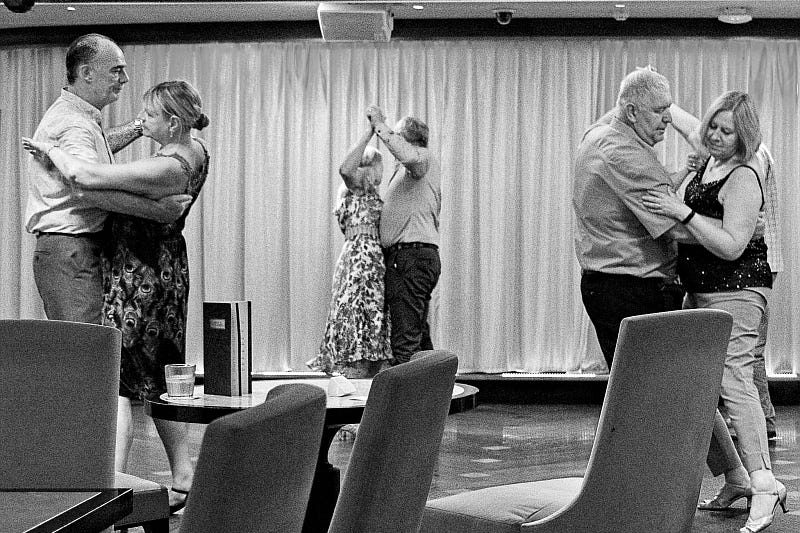
We humans can and do have numerous kinds of goals – small ones, like getting to the station on time, or reading two books every month, and large ones, such as ensuring a comfortable retirement, or making a scientific discovery worthy of a Nobel prize. But they can all easily be arranged in the same three categories. The kinds of things we do to attract a mate (and ensure our genes are passed on) may be more sophisticated than the rituals animals engage in, but they are not that dissimilar. Male bowerbirds build elaborate structures to impress their love interest, while humans might spend time and effort writing love poems or purchase expensive jewellery. Seahorses “engage in an intricate courtship dance, and swim together in perfect harmony”– much like humans do on the dancefloor. We also have a strong, and pretty much unconditional instinct for survival, and so some of our behaviour is aimed at fulfilling the more basic requirements in the hierarchy of needs pyramid associated (but not actually proposed by) Abraham Maslow. Physiological and security-related needs serve our survival, with goals such as earning enough money to live on, and having a decent roof over our heads to protect us against the elements and villains.
However, for us, thriving tends to be not only about living in peace and avoid stress so we can happily procreate, and survive in between episodes of procreating. We appear to have developed many needs that transcend those that are strictly required to ensure we can fulfil these first two goals, beyond what is adaptive. Within this third category we usually have so many goals of that we cannot possibly meet them all. That means we must compromise, and trade-off our resources – effectively choosing which of those flourishing goals we will pursue (and which we will not). They may even come into conflict with our primary goals.
Entangled in multiple goals
Some people choose not to have children, because they have aspirations in the third bucket that are not compatible with raising offspring. This immediately raises a problem with using rationality as a lens through which to evaluate choices. If we have, or plan to have children, is that a rational choice for us? Or if our choice is not to be a parent, is that a rational one? How would we even begin to work that out?
Furthermore, among the plentiful goals we want to pursue and the behaviours we exhibit, there are often some that may not directly be aimed at ending our lives, but that nonetheless increase the chance of a premature death – from drinking alcohol, walking up and down stairs, and travelling by car, to skydiving, mountaineering or scuba diving. Here too, there is no straightforward mechanism to determine whether such choices and behaviour are rational – however well we know our goals and preferences.
And it doesn’t get easier when it comes to goals and consequences that are not quite so profound as births and deaths, with their multifarious pluses (in the shape of enjoyment) and minuses (in the shape of direct and indirect financial cost, and opportunity cost). Comparing the minus sides, as long as they are expressed in neat measures like hours or currency, is not that hard, but the plus sides – the utility, as economists and decision theorists might call it – are rather trickier. How does the utility of reading a good book compare to that of redecorating the front room? What gives us more utility, a lavish dinner for two in a three-star restaurant, or a long weekend in a seaside B&B? Should we spend an afternoon tending to the grave of a parent, or tidying up the basement? (And I have not even mentioned moral dilemmas… Dang, I just did. Is it more rational to tell a white lie when arriving late for a meeting to conceal that we had completely forgotten about it, or to tell the truth?) We have no ‘utility exchange rate’, no way of expressing the utility different choices or different behaviour provides us with – and hence no way to work out what is the (most) rational thing to do.
A reader of last week’s article suggested that the Laws of Sense (or the Laws of Thought) might be able to settle whether we are making rational choices, notably the law of non-contradiction. For example, a smoker who acknowledges that smoking is harmful, yet smokes because it is beneficial might violate this law, which states that contradictory statements cannot be true at the same time. However, while this law is effective for scrutinizing an argument, it is less useful to judge real-life behaviour, because things can be regarded in many different respects. Smoking is detrimental for our respiratory and cardiovascular health, but can also relieve stress. How we weigh up the significance of both consequences is a personal choice, expressing what, in a given situation, we determine is the most important to us.

Perhaps the fundamental reason why using rationality as a criterion to judge our own choices is flawed is that the desired answer inescapably comes down to the solution of an optimization problem. If a rational choice appears less than optimum, then there must be a better, and hence an even more rational one. Yet the great polymath Herbert Simon already figured out the difficulty with this. When we seek to optimize we are on a fool’s errand: we are subject to bounded rationality. This reflects how human decision-making is limited by cognitive constraints, incomplete information and time pressures, preventing us from making perfectly rational decisions. Instead of optimizing, which requires exhaustive analysis and perfect information, of necessity we resort instead to satisficing—seeking a solution that is “good enough” to meet our needs and criteria. In other words, we (almost) always act in as rational a manner as we can.
The clarity and precision that rationality implies thus seems not to be compatible with the messy, fuzzy, imperfect way we live our lives. That does not mean we are being irrational. It doesn’t even mean that it is impossible for us to be irrational. But it means that rationality is not an appropriate guide by which to evaluate our choices and behaviour, to either divide it into a rational and non-rational, or to place them on a rationality scale.
If we maintain that we can, we are really bullshitting ourselves.