
Incorrigible self-persuaders
Humans’ cognitive capacity is unparalleled. But are we using it all that well when pre-cooked conclusions are available?

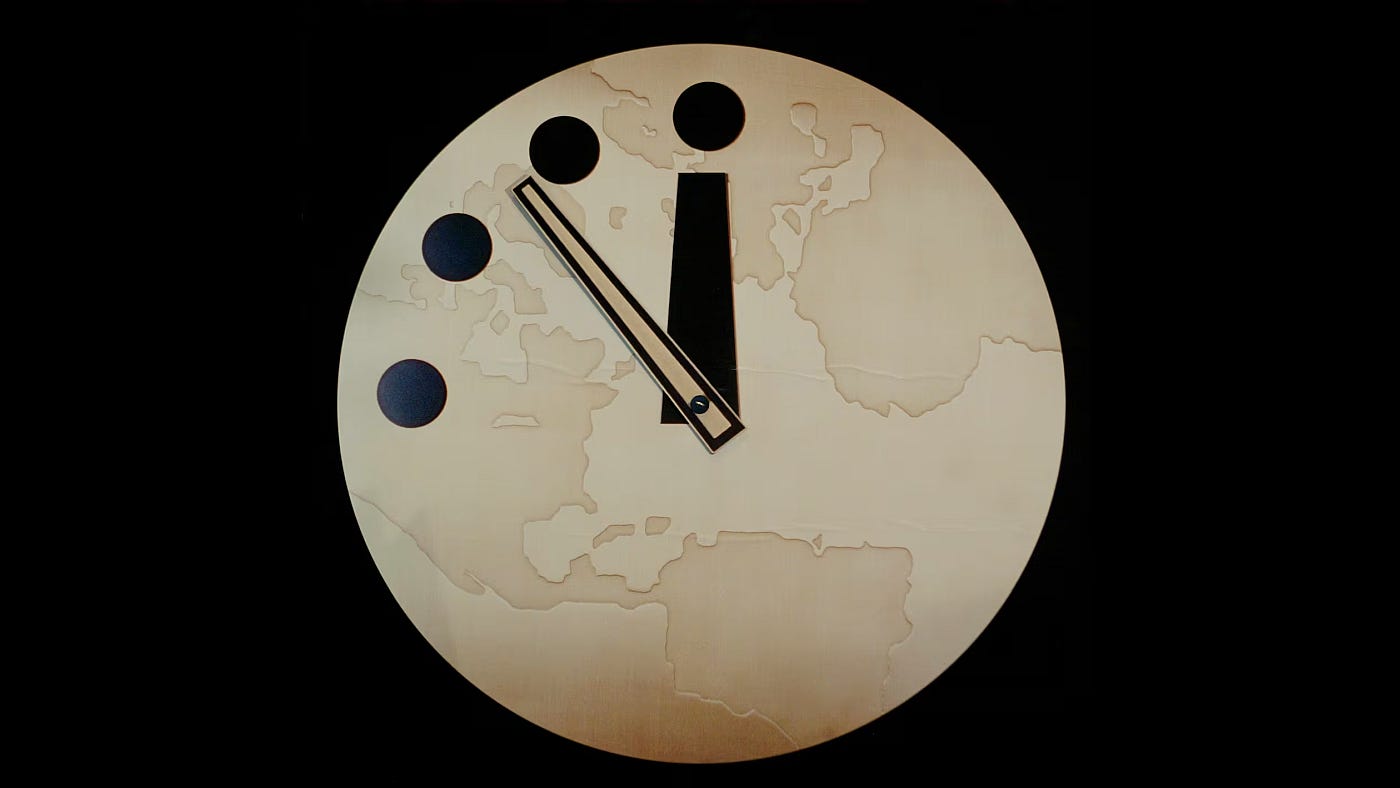
We are just 1 minute and 25 seconds from extinction. At least, that is what the Doomsday Clock tells us. Every year in January, the “time” on this device is assessed and potentially adjusted. First released to the world 79 years ago, in the aftermath of the nuclear bombing of Hiroshima and Nagasaki, it is a warning signal for nuclear and other existential threats our technology poses to our world. Initially set at 7 minutes to midnight, it has been adjusted 27 times – both back (the farthest to 23:43 in 1991), and forward (85 seconds to doom in 2026).
The use of a clock and of precise times (in 2025, it was adjusted by just one second) suggests an objective, quantified basis for expressing how close we are to extinction, and its custodians, the Science and Security Board of the Bulletin of the Atomic Scientists, implicitly lend it scientific credibility. But just a few seconds of reflection suffice to expose the lack of any quantitative, never mind scientific basis for the position of the minute hand that provides a factual cover for what is, in essence, a subjective judgment. And still, every year, this piece of theatre gets media attention as if it were genuine, sound analysis. Isn’t that odd?
Mmmm... pre-interpreted facts!
And this is not by any means a rare occurrence. Another January hardy perennial is Oxfam’s Global Inequality Report, which compares the wealth of the world’s billionaires with that of the poorest of the planet. Much like the Doomsday Clock, it offers a conclusion with what is presented as authoritative factual evidence. And there is more: Tax Freedom Day (the day we “stop working for the government”), Equal Pay Day (marking how many extra days an average woman must work to earn the same as the average man), and even Blue Monday (allegedly the saddest day of the year). Each oversimplifies complex issues through cherry-picked metrics, and they all share the same DNA: subjective advocacy dressed as objective analysis. Their purpose is not to inform, but to persuade.

The recurring, annual nature all but guarantees the attention of the media when their time arrives, but their most important attribute is their pre-cooked meaning, which gives ammunition to the audience’s existing beliefs, regardless what they are. If we happen to agree with the advocates, convinced we face multiple existential threats, we pay too much tax, or we really ‘feel’ the post-new-year slump is obvious, we see the pseudoscience (if we see it in the first place) behind it as a mere innocent simplification for communication purposes, and latch on to the implied underlying facts and the authority of the advocates and their experts. Our perspective is validated. If we happen to be more sceptical, we lock on to the dubious, selective facts and the laughable pseudoscientific certainty that is advanced, and point at the agenda of the advocates. And our view is validated just as well.
Normally, we need to interpret facts to figure out what they mean in practice (often specifically what they mean for us). Here, we are spared the cognitive effort and the emotional uncertainty (so, is it good or bad?). And perhaps even odder than the fact that we swallow this pantomime is the reason why we do: it gives us what we want. Far from telling us what to conclude, these events serve up the conclusion we want to reach, as if we have done the reasoning ourselves. The pseudoscience is not there to deceive us, it is there to give us permission to feel like we are actually thinking, and not just having our emotions confirmed. And while not intended for sceptics, it fulfils the same role here: its use itself justifies our disdain. Persuading someone is child’s play if they are already convinced, and they can pretend their belief is rooted in the sound reasoning that is offered.
It’s not them, it’s us
As Hugo Mercier and Dan Sperber argue in The Enigma of Reason, reasoning evolved principally as a social skill, not to discover the truth, but to underpin our own beliefs with reasons, and thus persuade others that they are correct. It also helps us spot arguments that support our position. This makes us not passive victims of these annual rituals, but active participants: we extract from them the support we need to justify our position.
Of course, we don’t need the Bulletin of the Atomic Scientists or the Tax Foundation to do this for us. We are skilled enough in filtering the facts we encounter through our prior beliefs, and quickly use facts and their meaning (or, at least, the meaning we ascribe to them) as if they are interchangeable. But it’s not because we can cook a decent meal that we don’t appreciate food prepared by someone else – and neither would we decline a readymade conclusion, complete with pseudoscientific preamble that totally confirms our view. These rituals are just the professionalized version of what we do instinctively every day. They succeed because they mirror our natural cognitive process—they just do it more efficiently, at scale, with a veneer of scientific legitimacy.
Are the advocates behind them to blame for feeding us pre-cooked inferences? After all, they do no more than what we all do: using the instruments that evolution provided us with as they were intended, and cook the factual ingredients into the best possible argument to persuade others. If we end up persuaded that Oxfam are a bunch of charlatans twisting and bending data to serve up an ideologically biased story, we can hardly lay that at their feet. When the same argument can persuade one person to subscribe to it, and another one to adopt the polar opposite, it is because we want to be persuaded, whatever we believe.
This process is our evolutionary default: we are wired to seek persuasive ammunition, not uncomfortable truths. It has done (and still does) a fine job for social cohesion and coalition-building. While the Doomsday Clock will tick on, Blue Monday will return next January, and so on, we can keep reaching for pre-interpreted conclusions. But we don’t have to. Nothing stops us from using that same reasoning circuitry to seek to understand, and perhaps to persuade ourselves to change our mind.
Nothing but we, ourselves.
The doomsday clock is clearly a rhetorical device, but also acts to offer us a chance to consider the reality. And you might have noticed that events of the past year have been even more harrowing than is generally the case.
Meanwhile why not read this essay on the cooking of the planet.
http://johnmenadue.com/post/2026/02/the-collapse-of-nature-and-what-it-means-for-us
A related reference re the inherently destructive nature of human beings at our present-time very diminished current level of development
http://fearnomore.vision/human/what-man-represnts