
Casting judgment
A controversy over a casting decision reveals how we sometimes try to rationalize ideological or identitarian positions, and allow peripheral concerns to eclipse the essence of the matter


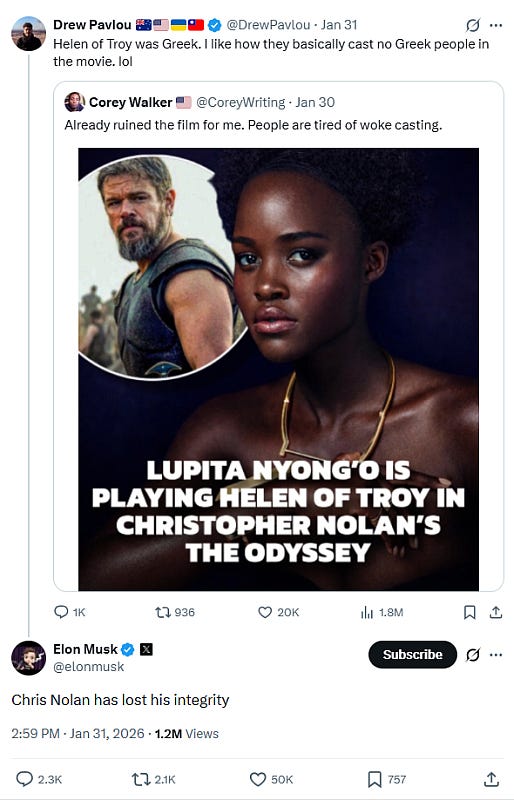
Homer’s Odyssey is an enduring tale that, unsurprisingly, continues to inspire movie directors, most recently Sir Christopher Nolan, whose $250 million production, The Odyssey, is slated for release later this Summer. The casting has led to some controversy: the role of Helen of Troy will be played by the black Mexican-Kenyan-American actor, Lupita Nyong’o, a choice that turned out not to everyone’s taste. Sir Christopher “has lost his integrity”, tweeted Elon Musk, in response to some posts expressing outrage, with numerous comments supporting the critical sentiments voiced. According to them, a supposedly white person’s part should be played by an actor with a white skin. Judging an actor’s suitability not based on the essential demands of the role, but on their conformance to a constructed and inconsequential image… isn’t that odd?
Who needs pictures on the radio?
Moving to the UK, many years ago, reignited my enjoyment of radio plays, which had all but disappeared in Belgium. One early classic was the daily soap opera, The Archers. Naturally, I only knew the actors by their voice, but occasionally, one of them appeared on TV or I saw their picture in the programme guide, and it was striking how – despite not actually having a clear image of the characters – I often felt they looked nothing like how I would have imagined them. I did not have an idea of Kenton Archer’s hair length or colour, but discovering he is bald was certainly a surprise.
Even absent any narrative cues of appearance, most people spontaneously confabulate mental pictures of objects, places and people. That may feel like a legitimate expectation, and when their actual appearance is different, the incongruence naturally jars. But what really is the legitimacy? There may be physical requirements to support authenticity where needed – hobbits are small creatures, so Arnold Schwarzenegger might not be a perfect fit for Bilbo Baggins, and Robert Redford would have little credibility as a choice for the title role in a biopic about Malcolm X. But it is hard to see why a character’s failure to correspond to an idiosyncratic mental image – or even an immaterial literary description – should be problematic.
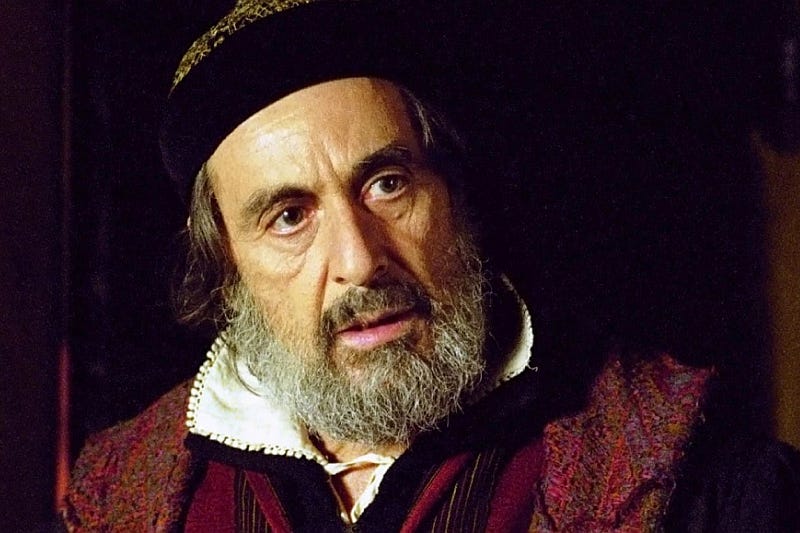
Authenticity is not a clear-cut matter, though. In Shakespeare’s time, plays used to be staged with an all-male cast, regardless of the roles. Should this imply that present-day performances really ought to honour that custom? Or precisely the opposite? What to make of the role of the ‘dame’ in the British panto genre, played by cross-dressing men, typically to comic and demeaning effect. And there are other authenticity conundrums. Should one criticize the casting of Al Pacino or John Gielgud in the role of Shylock in Shakespeare’s Merchant of Venice, and applaud picking a Jewish actor instead? Or should one condemn such casting as a case of blatant essentialist condescension? Clearly, the issue is not about the dramatic art, not a matter of inauthenticity, and not a violation of a fundamental principle.
Arnold Kling’s three languages of politics, notably the two of conservatives and progressives (or liberals) might help explain why this is such a hot potato. He argues that the overriding concern of the former tribe is preserving and protecting Western values, and defending society against “the assault on moral values and traditions that are the foundations of our civilization.” The latter tribe tends to focus on the rights of the underprivileged – in particular minorities. If one’s sole concern is either of these issues, it is easy to see why a black actor in the role of Helen of Troy is a big deal, and that a compromise will be hard to establish. Here, conservatives consider the casting as a direct attack on inherited cultural authenticity, while progressives see it as a laudable correction to historical exclusion. Both are coherent positions, given the respective premises, but the problem is that neither is material to the dramatic art itself. One perceives a deviation from a prevailing norm, the other a step towards a new one. And yet, on either side, no number of ‘correct’ castings would neutralize a single ‘wrong’ one: norm violations cannot be remedied by compensation.
Illusory neutrality
The underlying problem is, of course, that there is no such thing as a neutral norm in casting, much like there is no neutral choice architecture (the way options are presented inevitably shapes the choices people make) in behavioural economics. That doesn’t stop us from appropriating the neutrality category for whatever is our preference or, more broadly, whatever we feel is ‘right’: without that cloak of neutrality, our insistence on how the casting should be done would be seen as petty and self-centred (and not without reason). But the very act of selecting leads to a particular choice – even if the selection is random. Only one dessert item can be placed at eye level in the canteen: either the unhealthy, but appealing donut or the healthy but a bit dull banana , and neither is ‘neutral’. Helen of Troy might have been played by Lupita Nyong’o, or by, say, Klelia Andriolatou: one black-skinned, established, famous, born in Mexico, the other is white-skinned, up-and-coming, not famous, and (aptly) born in Greece. Here too, neither is neutral: actors are not just actors – they have an identity, and every single attribute, intentionally selected for or not, might be taken as significant and symbolic of something objectionable.
We see two phenomena interacting here in shaping, or indeed misshaping our judgment. The first is the selective recruitment of ostensibly objective reasons and basic principles to argue about a subjective, ideological norm violation. However, that quickly becomes a logical trap. Supposed authenticity – as a principle – is de rigueur when the actor chosen does not conform to the skin colour of a conventional portrayal of the character, but is objectionable if the actor is chosen for their specific ethnic facial traits; applauding the choice of, say, a Latino actor in an unremarked role, but complaining about casting an actor of the same ethnicity as a Colombian drug baron is the parallel trap. The second phenomenon is the tendency then to elevate the recruited principle to the primary criterion for judgment, eclipsing the actual essence of what ought to be judged.
Both are red flags where sound judgment is concerned, but while the former can be excused (though not justified) as a common cognitive bias, an instance of post-hoc rationalization, the latter is where the actual failure of judgment takes place. Sir Christopher Nolan’s film should be judged by the standards and norms of cinematic craft, and not disqualified for social or ideological preferences masquerading as authoritative criteria before we have even seen the trailer. The director’s artistic freedom is absolute to realize the vision, and it is this overall result that deserves our considered appraisal, not conformance to idiosyncratic details with no demonstrable relevance to the work.
The same mechanisms can surface wherever we make value or moral judgements. The label on a bottle of wine should not matter, yet wine tastings are still blind: the label recruits the principle, and the principle then overpowers the wine. A foul on the football pitch looks entirely different depending on which shirt you’re wearing.
Plenty of opportunity for spotting questionable judgments!