


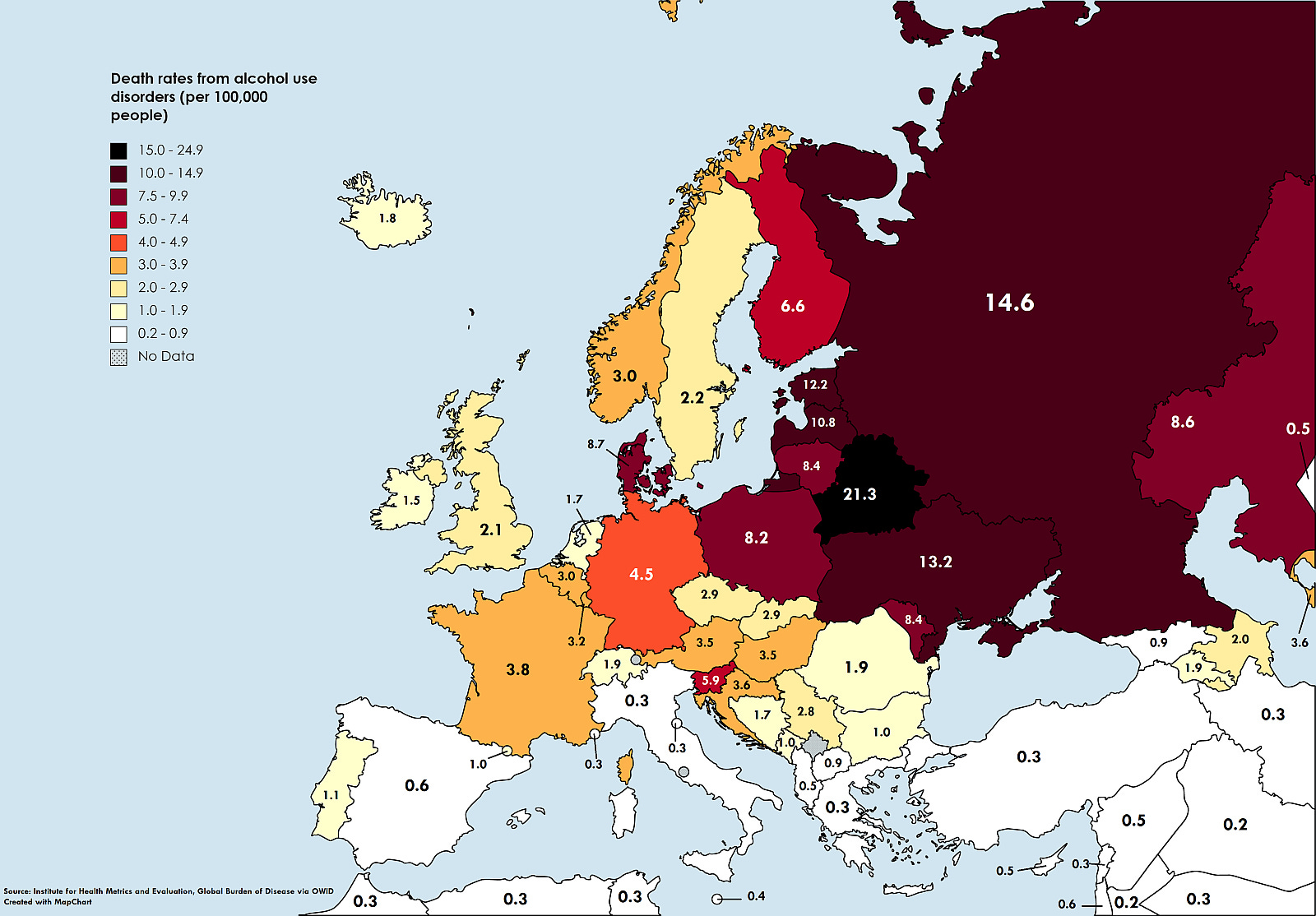
An intriguing chart recently passed through my Twitter timeline, showing the prevalence of alcohol abuse-related deaths in Europe. Overindulgence appears alarmingly high in Central and Eastern European countries, and exceedingly low in mediterranean countries like Spain, Italy and Greece. With annual consumption per capita of 6-9 litres, these are not countries of teetotallers, but they have also a culture in which alcohol is mostly consumed with meals – a strongly social activity – and in which drunkenness is frowned upon.
It would seem that the social norms in these mediterranean countries trump conventional legislation aimed at curtailing alcohol abuse – duties, restrictions on sales, bans on consumption in public places and penalties for drunkenness in public. Yet the law is governments’ instrument of choice when they want to regulate social behaviour – from boozing and cruising to littering and hate speech. Isn’t that odd?
Laws and behaviour
When most of us refrain from stealing, vandalizing property or attacking our fellow citizens, it is not because we are deterred by laws prohibiting it and fear punishment. It is because we know it is wrong to do so, even if it would benefit us. Most of us have internalized norms that tell us what is right and wrong, and we tend to act accordingly. We behave in accordance with virtue or deontology ethics, which emphasize internal moral principles guiding behaviour based on inherent rightness, rather than external consequences. This mechanism is strategic and enduring: generic norms of right and wrong were the behavioural drivers that stood at the cradle of humanity as a social species, and today still steer us across many situations whenever they are pertinent.
Laws and legal punishment arose much later, and are much more transactional in their effect: if you transgress (and get caught), you’ll face a penalty. In contrast with ethical norms, to be successful, this mechanism must make sure that, for every relevant situation, the punishment is such that it is perceived to outweigh the benefit one might derive from breaking the law.
Norms derive their effectiveness in part from evolutionary adaptation. They were what bound our ancestors’ tribal communities together, and non-compliance was frowned upon, potentially punished with ostracization. In today’s societies, the equivalent is “antisocial behaviour”: we still instinctively aim to obey the norms of the tribe(s) we belong to, and shun those who don’t. Moreover, insofar as the processes of law align with our social norms of right and wrong, we consider them fair and legitimate, and we abide by them. This is known as procedural justice (a term coined by law and psychology academic Tom Tyler, distinctive from retributive justice, which relies on the threat of punishment, or distributive justice, which seeks the fairness of outcomes. Social norms also tend to align strongly with personal values, which makes them enduring as mechanism for behavioural regulation, and rooted in intrinsic motivation rather than costly external coercion.
Why can laws be ineffective? Classic research by Uri Gneezy and Aldo Rustichini illustrates how negative incentives can backfire. Parents were routinely turning up late to pick up their offspring from a daycare centre, causing staff to have to stay late. When the centre introduced a system of fines, even more parents began arriving late, treating the fine as a price to pay for the extra time. Economist Gary Becker had earlier already coined the concept of the rational criminal, who calculates that, even with the penalty, he or she would still be better off. Furthermore, the mere imposition of legal restrictions can be perceived as a threat to behavioural freedom, and trigger wilful non-compliance, a phenomenon known as reactance.
But not everyone abides by laws and social norms. Psychologist Lawrence Kohlberg proposed a theory of staged moral reasoning development, with a pre-conventional phase, where obedience and punishment are central, a conventional phase, where law and order morality emerges, and a post-conventional phase, characterized by the adoption of universal ethical principles. Kohlberg speculated that many people never reach that ultimate phase. For them, behaviour regulation requires the instruments of the earlier stages – law and order, and incentives and punishment engaging people’s self-interest.
Losing our norms
Two potential problems arise here. One is that when legal penalties fail to meaningfully deter behaviour, they risk transforming from a regulatory mechanism to a mere transaction cost. Transgressions become normalized and the prevailing norms erode: if dropping litter is rarely penalized, more and more people will stop bothering to place their trash in the bin. The other is that it tends to replace the intrinsic motivation of people’s moral compass with the transactional logic of incentives: when we stop refraining from unwanted behaviour because we think it is wrong, and only desist because we want to avoid punishment, then that becomes the driver of behaviour. It doesn’t take much imagination to see what a society in which punishment avoidance determines behavioural choices might be like.
The tide of ever growing legal and paralegal texts seems hard to stem: not just legal codes, but also documents like corporate handbooks, university conduct codes, or professional ethical guidelines become thicker and longer, absorbing codifications of social norms. In addition, the responsibility for guarding those norms morphs into more repressive enforcement by dedicated functions – HR, the police, ethics committees. The precision of the written word and dedicated guardians suggest better, more objective control, offering a bureaucratic simplification of the complex dynamics of fuzzy, unwritten social norms.

Societal changes have implicitly contributed to this shift. Advancing urbanization (56% of the global population now lives in cities) has worn away the sense of community of villages where families lived for generations, and people knew not just their neighbours, but most of the village. The implicit collective responsibility of people with a clear, perceived stake in the good operation of their community has evaporated as people became more mobile. Urban living is much more anonymous, and social monitoring by strangers is much less likely. Sociologist Zygmunt Bauman termed this “liquid modernity” – people move fluidly through social positions: new house, new job, new spouse, new values, and lose traditional support structures. This might explain the appeal of the apparent certainty of the law.
But while legal frameworks work well in areas like contract law and trade regulations, they are far less effective to regulate social behaviour, guide interpersonal conduct and respond to nuanced ethical challenges. The law may appear to remove the ambiguity of social norms, but that clarity is illusory. Enforcement of laws and regulations on hate speech, antisocial behaviour, harassment, or public protests is not just open to interpretation and political bias. It creates technical compliance, but without a genuine ethical understanding, and erodes personal responsibility, stokes repression and suppresses free expression.
Much like hard incentives can crowd out intrinsic motivations, so laws and associated enforcement can weaken the influence of social norms. Instead of a deep and enduring inner sense of what is right and wrong, we slip into a transactional engagement with society, concerned primarily with avoiding punishment – and that does not necessarily mean toeing the line, but exploiting the low chance of being caught, or actively evading it.
Our social interactions are not static, but dynamic ecosystems constantly negotiating between formal rules and unwritten expectations. Understanding this complexity invites us to be more intentional about how we establish and maintain the norms that bind us together. If we want to safeguard the essence of a well-functioning society, the challenge is clear: avoid resisting change, and instead consciously shape the social mechanisms that reflect our collective values.